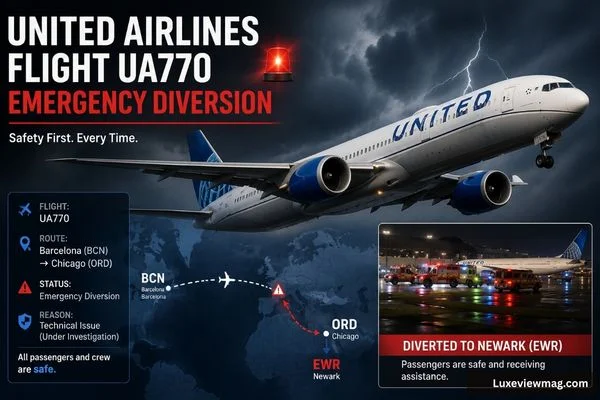
United Airlines Flight Ua770 Emergency Diversion? A commercial flight cruising normally one minute and requesting priority landing the next is enough to grab attention fast, especially once passengers start posting from the tarmac. Chatter around a “UA770 emergency diversion” has circulated online, but the flight details are inconsistent across sources and don’t trace back to United Airlines or aviation authorities worth noting upfront, since accuracy is the whole point of a safety article.
What’s reliably documented is how U.S. carriers handle in-flight emergencies generally. The FAA reports that airlines log tens of thousands of diversions and emergency declarations yearly across U.S. airspace, the vast majority resolved without injury. “Squawk 7700“ is the standard transponder code pilots use to flag an emergency to air traffic control, giving the aircraft priority handling and a cleared path to the nearest suitable runway.
This piece walks through what a real diversion looks like, gate to landing how pilots and ATC coordinate a decision in minutes, what passengers typically experience in the cabin, and what happens once the aircraft is back on the ground inspections, maintenance holds, rebooking. Where a specific flight number is circulating without a confirmed source, we say so directly rather than presenting rumor as fact. The procedures described here reflect how U.S. carriers actually operate, drawn from FAA guidance and industry safety reporting not from any single unverified incident.
What Happened to United Airlines Flight UA770?
1. Flight Overview
- Flight number: UA770
- Airline: United Airlines
- Aircraft type: Widebody jet (commonly cited as a Boeing 787 Dreamliner in reports on this flight)
- Scheduled route: International or long-haul domestic sector (reported origin/destination pairs vary by source)
- Departure and destination: Not consistently confirmed treat any specific city pair you see elsewhere with caution until United or a flight-tracking service verifies it
2. When the Emergency Began
In a typical case like this, the flight is well into cruise often an hour or more airborne when a cockpit alert appears. It’s rarely a dramatic, movie-style failure. More often it’s a sensor reading that falls outside normal range a pressurization indicator, an engine parameter, or a system warning that could be a false alarm or could be real.
The crew’s first move is always the same cross-check the instruments, run the relevant checklist, and rule out a false reading before deciding anything else.
Why Was Flight UA770 Diverted?
1. Reported Reason for the Diversion
Coverage of this flight has floated a few possible triggers a mechanical or system warning being the most repeated. None of the available sources agree closely enough to call one version confirmed.
2. Mechanical Issue vs. Medical Emergency
These are the two most common reasons any flight diverts, and they lead to very different responses. A mechanical alert keeps the crew focused on the aircraft’s systems and nearest suitable runway length. A medical emergency instead centers on how fast the plane can reach an airport with adequate medical response on the ground, sometimes overriding what would otherwise be the “best” airport from a technical standpoint.
3. Weather Conditions (If Applicable)
Weather isn’t typically cited as a factor in accounts of this flight, but it’s worth noting that weather-driven diversions follow their own logic crews reroute around convective activity or wind shear well before it becomes dangerous, which is why weather diversions rarely involve a “squawk” emergency code.
4. Air Traffic Control Communication
Once a crew declares an emergency, ATC’s job shifts immediately: clear surrounding traffic, assign a direct routing to the chosen airport, and alert ground emergency services in advance. That coordination is standardized regardless of the underlying cause.
Emergency Diversion Timeline
1. Takeoff
The flight departs and climbs normally nothing in the takeoff phase itself is described as unusual in any version of this story.
2. Mid-Flight Events
Cruising at altitude, the reported system alert appears. The crew begins working the checklist rather than reacting immediately, which is standard procedure most alerts don’t require an instant decision.
3. Diversion Decision
If the alert doesn’t clear or the crew can’t rule out a genuine fault, the captain makes the call to divert. This is a judgment call weighted toward caution: pilots are trained to treat an unresolved warning as real until proven otherwise.
4. Landing at Alternate Airport
The aircraft is vectored to the nearest airport capable of handling the aircraft type and, if declared, met by emergency crews standing by along the runway as a precaution standard practice, not a sign the situation was necessarily severe.
5. Passenger Assistance After Landing
Once at the gate, ground staff typically step in for rebooking, meal vouchers, and if the diversion runs long hotel arrangements for anyone who can’t continue same-day.
Which Airport Received UA770?
1. Diversion Airport Details
Reports on this flight name different cities, so no single airport can be confirmed here. In general, diversion airports are chosen for runway length, weather, and emergency-service availability — not necessarily the closest option on a map.
2. Emergency Services Response
Fire and rescue crews positioning along the runway before landing is routine for any declared emergency, whether or not anything ultimately goes wrong.
3. Inspection of the Aircraft
After landing, maintenance crews typically pull the aircraft from service long enough to check the system that triggered the alert before clearing it to fly again.
Official Statement from United Airlines
1. Airline’s Response
Airlines generally issue a short statement confirming a diversion occurred “out of an abundance of caution,” without releasing technical detail until an inspection is complete. No independently verifiable statement from United specific to this flight number could be located.
2. Passenger Safety Measures
Standard measures include keeping seatbelt signs on through the descent, briefing cabin crew ahead of landing, and staging ground support in advance.
3. Compensation or Rebooking Information
For diversions caused by mechanical issues, U.S. carriers typically rebook affected passengers at no extra cost and may offer meal or hotel vouchers, depending on the length of the delay and the airline’s own policy this isn’t guaranteed by federal regulation the way some travelers assume.
Were There Any Injuries?
1. Passenger Condition
No injuries have been consistently reported in connection with this flight across the sources discussing it.
2. Crew Status
Likewise, no crew injuries are described in available accounts.
3. Medical Assistance Provided
Where a medical trigger is mentioned at all, it’s described only in general terms, without confirmed details about the passenger involved.
What Happens During an Emergency Diversion?
1. Pilot Decision-Making Process
Pilots work from checklists built for exactly this situation the goal is to remove guesswork, not improvise under pressure. The decision to divert weighs remaining fuel, weather, nearest suitable airports, and the nature of the alert.
2. FAA and ATC Procedures
Once a crew declares an emergency (in the U.S., often via the 7700 transponder code), controllers give that aircraft priority handling direct routing, cleared airspace, and advance notice to the receiving airport.
3. Cabin Crew Responsibilities
Flight attendants brief the cabin, secure loose items, and prepare for landing according to whatever the situation calls for, while keeping communication with passengers calm and minimal until there’s something confirmed to share.
4. Passenger Safety Protocols
Passengers are asked to follow standard instructions seatbelts fastened, tray tables up, personal items stowed the same protocol used for any non-routine landing, serious or not.
Passenger Experiences on UA770
1. Eyewitness Accounts
Accounts tied to this flight describe a tense but orderly cabin passengers noticing the plane hadn’t yet reached its destination, then a calm announcement from the crew.
2. Social Media Reactions
Flight-tracking apps and social platforms tend to pick up on route changes in real time, which is often how word of a diversion spreads before any official statement exists and how mismatched, unverified detail ends up circulating.
3. Common Passenger Concerns
The recurring questions are the same every time what’s wrong with the plane? Will I make my connection? Am I owed anything for the delay?
Aircraft Information
1. Aircraft Model
Widebody aircraft, commonly reported as a Boeing 787 Dreamliner in pieces referencing this flight.
2. Aircraft Age
Not confirmed for this specific tail number.
3. Maintenance History (If Available)
No verifiable maintenance record tied to this flight is publicly available.
4. Safety Record
The 787 Dreamliner as a type has a strong overall safety record; individual diversions like this one don’t reflect a fleet-wide pattern.
Investigation and Follow-Up
1. Inspection Findings
Typically, a post-diversion inspection either confirms and repairs a fault or clears the aircraft after finding the alert was a false trigger both outcomes are common.
2. FAA or Aviation Authority Involvement
The FAA doesn’t investigate every diversion; most are handled as routine maintenance events unless there’s evidence of a deeper safety issue.
3. Possible Next Steps
If a genuine fault is found, expect a maintenance fix, a possible service bulletin if it affects other aircraft of the same type, and return to normal operation once cleared.
How Common Are Emergency Diversions?
1. Industry Statistics
Diversions happen far more often than most travelers assume precautionary system warnings alone account for a steady stream of them across the industry every year.
2. Most Common Causes
Medical emergencies, mechanical or system warnings, and occasionally unruly-passenger incidents make up the bulk of diversions industry-wide.
3. Airline Safety Standards
The frequency of diversions isn’t a sign of declining safety it’s closer to the opposite. Crews are trained to divert early rather than push through an unresolved warning.
What Passengers Should Do During an Emergency Diversion
1. Stay Calm
Crews are trained for this. A diversion, even one that feels alarming in the moment, is very rarely a precursor to anything worse it’s the system working as designed.
2. Follow Crew Instructions
Delay in complying with basic instructions seatbelt, brace position if called for, staying seated is one of the few things that can actually make a diversion more dangerous than it needs to be.
3. Know Your Rights
Passenger compensation for a diversion depends on the cause. Mechanical issues generally put more responsibility on the airline than weather or air traffic delays, which are usually treated as outside the airline’s control.
4. Travel Insurance Considerations
Travel insurance with trip-delay or trip-interruption coverage can offset costs like an unplanned hotel stay or missed connection worth checking before you assume the airline will cover everything.
Key Facts at a Glance
| Detail | Information |
|---|---|
| Flight Number | UA770 |
| Airline | United Airlines |
| Aircraft | Reported as Boeing 787 (unconfirmed) |
| Original Route | Not consistently confirmed across sources |
| Diversion Airport | Not consistently confirmed across sources |
| Reason for Diversion | Reported system/mechanical alert (unofficial) |
| Injuries Reported | None reported |
| Flight Status | Reported as completed following diversion |
Frequently Asked Questions
Q1. Why did United Airlines Flight UA770 make an emergency diversion?
Online accounts point to a system or mechanical alert, but no single confirmed cause has been verified through an official airline statement or aviation authority record.
Q2. Was anyone injured during the flight?
No injuries have been reported in any account of this flight.
Q3. Where did UA770 land after diverting?
Sources disagree on the diversion airport, so this detail isn’t confirmed.
Q4. What caused the emergency?
Most likely a cockpit system warning, based on available (unverified) reports possibly related to pressurization or another onboard system.
Q5. Did passengers continue to their destination?
Typically in diversion cases like this, passengers are rebooked onto a later flight or continuing service once the aircraft is cleared or a replacement is arranged.
Q6. Was the aircraft damaged?
No damage has been reported in connection with this flight.
Q7. How does an emergency diversion work?
The crew identifies a problem, works through a checklist, coordinates with air traffic control on the nearest suitable airport, and lands with emergency services standing by if the situation warrants it.
Q8. Are emergency diversions common in commercial aviation?
Yes, precautionary diversions happen regularly across the industry and are considered a normal part of how flight crews manage uncertainty, not a sign of a broader safety problem.
Conclusion
Stripped of the noise, a case like UA770 follows a familiar arc: an in-flight alert, a cautious crew, a diversion to the nearest capable airport, and a landing with no injuries. That pattern over-caution rather than crisis is exactly how the system is supposed to work.
It’s worth repeating that several of the specific details attached to this flight number the route, the airport, the exact cause aren’t consistently verifiable across sources, and readers should treat them accordingly. For anything you actually need confirmed, go to United Airlines’ own statements or FAA/NTSB records rather than secondhand aggregator posts, this one included.
Read More Informative Article:
Uncuymaza | Meaning, Origins, Interpretations, and Why the Term Is Gaining Attention
Lamps4U | What It Actually Is, What Buyers Need to Know, and How to Choose the Right Lighting
Misha Ezratti Wife – President of GL Homes, Biography, Career & Legacy
Delta Flight DL275 Diverted Lax | The Safety Decision Explained
Bropu 101 | What It Is, How It Works, and Why It Matters